
Summary
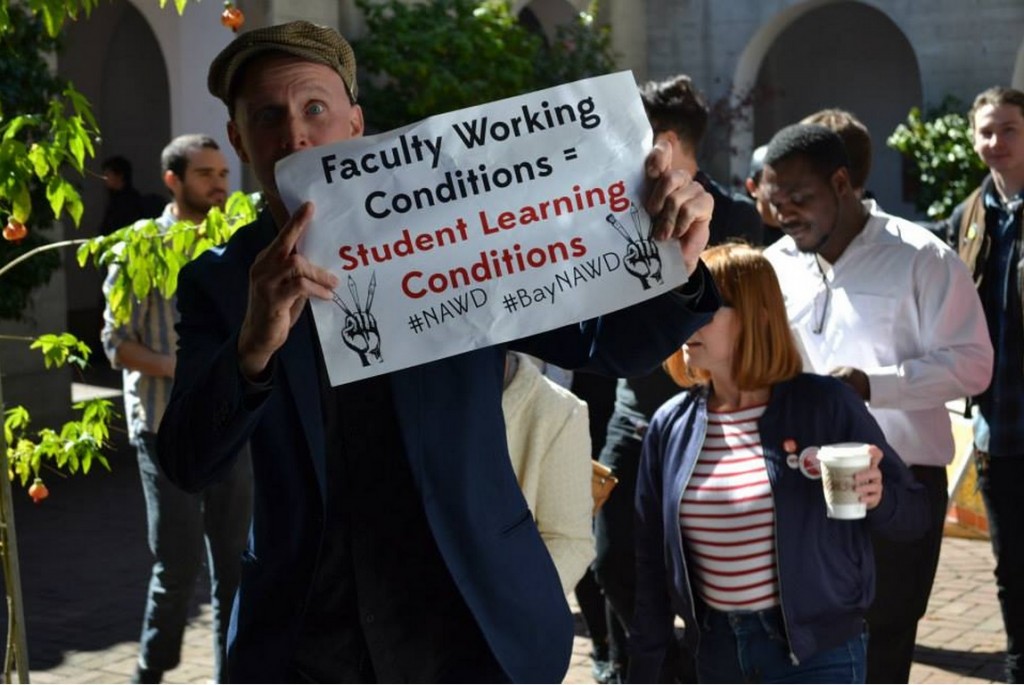
- Adjunct faculty are professors who lack the pay, benefits and job security necessary not only to live a stable, healthy life, but also to properly educate the students who depend on them.
- We must enact reforms to guarantee adjunct professors decent conditions, including job security, livable salaries, and benefits such as healthcare and retirement coverage.
- We are proposing two related bills to address these issues: the Adjunct Faculty Reform Act (AFRA; SD.1664/HD.2813) and the Adjunct Faculty Pilot Program (APP; (H.1434/ S.934).
To bring long-overdue improvements to the treatment of adjunct faculty in Massachusetts colleges, PHENOM is campaigning for two amazing bills: the Adjunct Pilot Program (APP) and the Adjunct Faculty Reform Act (AFRA).
These are two bills that would guarantee adjunct faculty the pay, support and stability they need to lead lives of dignity and give their students the best education possible.
These two pieces of legislation both propose improvements to adjunct faculty’s working conditions, but they differ in scale. Use our letter campaigns to send a pre-written letter to your legislators (or write or own!) urging them to support the Adjunct Faculty Reform Act and the Adjunct Pilot Program!
What would the Adjunct Faculty Reform Act do?
The Adjunct Faculty Reform Act is what we call “benchmark legislation”, or ambitious legislation that envisions the highest level of comprehensive reform.
While less pragmatic, this bill’s bold vision for a deep overhaul of adjunct faculty conditions gives us a roadmap for long-term changes.
The Adjunct Faculty Reform Act would:
- guarantee adjunct professors minimum pay, benefits and job security,
- ensure opportunities for promotion and professional development, and
- create a more inclusive, dignified experience through access to college resources, office space, and a voice in faculty decision-making.
What would the Adjunct Pilot Program do?
The Adjunct Pilot Program is AFRA’s much less comprehensive but more pragmatic little brother.
The Adjunct Pilot Program offers a pared-down trial-run of the most practical reforms of the former bill over a three-year trial period.
The Adjunct Pilot Program would:
- provide adjunct faculty with expanded opportunities to get promoted,
- give adjunct faculty access to departmental resources and workspaces, allowing smoother communication between faculty, students, and administration, and
- test essential benefits such as healthcare, which have long been denied to MA adjuncts.
Because it is both simpler than AFRA and a temporary pilot program, the APP is much easier to pass: it would only cost $2 million per year, is temporary, and would be targeted to only three college campuses.
Because it stipulates a commission to monitor its performance, we could learn from its successes and failures to make future legislation for adjunct faculty even better. Moreover, the parts that are successful would generate support for more ambitious bills such as the Adjunct Faculty Reform Act.
Diving Deeper
The Adjunct Faculty Reform Act
In order to stop colleges from cheating adjuncts out of full-time status by separating “day” and “continuing education” courses, the Adjunct Faculty Reform Act (SD.1664/HD.2813) guarantees equal pay and benefits for these classes.
It also guarantees compensation adjusted for cost-of-living differences, compensation for departmental and committee services, and compensation for preparing a course if it gets cancelled.
Job insecurity is one of the other gravest issues adjuncts face, so this bill entitles adjuncts to a standard two-year contract after four successful semesters of teaching at a certain university.
In order to fix the problem of adjunct professors not knowing about class assignments in time (which creates crippling uncertainty about the ability to pay bills), the bill ensures professors hear about class assignments at least 45 days before their start dates. In addition, this bill would protect faculty from arbitrarily having their teaching contracts renewed.
This bill also provides for expanded career advancement opportunities. Specifically, this bill outlines a three-tier system with more job security, compensation and benefits with each level. It ensures clear criteria for advancement while mandating transparency and fairness in the promotion process. The icing on the cake? The most eligible adjuncts will get priority consideration for full-time professorships.
To ensure adjuncts get the benefits they need and deserve, this bill guarantees eligibility for healthcare, social security and representation in benefit decisions.
To ensure adjunct faculty can benefit from the extensive resources as well as academic and professional opportunities of campuses they work at, this legislation also outlines access to research grants, mentoring opportunities, help with conferences, as well as yearly funding for professional development. To supplement these material benefits, this bill also guarantees the opportunity to take part in faculty governance and faculty meetings.
Finally, in order for all of this to go through, this legislation lays out requirements for oversight, regulation and enforcement to ensure that adjuncts get to keep these long-deserved wins.
These detailed regulations would go hand in hand with resources to monitor institutions’ compliance, investigate violations, and punish noncompliance accordingly.
To empower adjuncts to stand up for themselves and be at the mercy of colleges no longer, this bill also would give them protection from retaliation as well as a system for requesting enforcement and appealing decisions.
The Adjunct Pilot Program
The Adjunct Pilot Program (H.1434/ S.934) is a uniquely promising piece of legislation because it would test out several major long-overdue reforms for Massachusetts universities’ adjunct faculty.
The Adjunct Pilot Program would give adjunct faculty improvements in three key areas: career advancement, better working conditions, and benefits.
Through the bill’s career advancement framework, adjunct faculty would have expanded opportunities to get promoted and be truly rewarded for all of the work they do.
As for better working conditions, adjunct faculty could use department resources and workspaces, which would help adjunct faculty be more productive and be the best teachers possible to their students.
Finally, the Pilot Program would guarantee adjunct faculty healthcare coverage, a necessity the majority of adjunct faculty have been denied.
By testing out the implementation of key reforms such as healthcare benefits, career advancement and improved resources, this bill would pave the way for the passage of a future adjunct faculty bill that is much more comprehensive. All the while, it would show policymakers what works and what does not so they can make improvements to existing legislation.
The program would also only be tested at three universities, with one from the community college system, one from the state university system, and one from the University of Massachusetts system. In order to ensure the selection process is competitive, the program will have institutions provide matching funds of at least 25 percent.
To make sure policymakers can learn from the Adjunct Pilot Program and make adjustments to more comprehensive legislation, the bill provides for the establishment of a 13-member oversight committee with stakeholders from all parts of the higher education community: from adjunct professors to students to teachers’ unions to the Department of Higher Education.
The provision of healthcare coverage is the most obvious benefit of this proposed program. According to a 2023 national survey of American Federation of Teachers (AFT) adjunct faculty, only 45 percent of AFT adjuncts received health insurance from their university employers. The Adjunct Pilot Program stipulates that any adjunct faculty that teaches 50 percent of a full-time load is eligible for healthcare coverage.
The creation of a two-tier promotion system for adjuncts as well as improved access to workspaces are also key. According to that same AFT survey, only 22.5 of the adjuncts surveyed had continuing employment beyond a single-semester contract. Moreover, two thirds wanted to work full-time but were only offered part-time work.
Adjunct faculty also typically lack access to adequate workspaces, let alone shared office spaces, which are necessary for preparing teaching materials, meeting with students, and other potential duties of adjuncting. This legislation would remedy this with guaranteed shared office space for student meetings, as well as access to other essential departmental resources.
Background
The original purpose of adjunct professors was to give retired professors and experts more flexibility to teach. But in recent decades, it has been corrupted into another example of today’s exploitative gig economy, as one long-time adjunct notes.
The percentage of tenure-track professors making up teaching faculty at universities was 78.3 in 1969. But by 2011, full time positions only accounted for 19.1 percent, while 51.2 percent of positions were for adjunct faculty.
Instead of recognizing the importance of full-time, tenured professors who have the time, salaries and peace of mind to properly teach their students, universities have replaced them with scores of teachers who cannot earn tenure and have little to no job security.
This doesn’t only hurt professors and their families: it also hurts students.
This model is not sustainable. One 2019 survey found the median adjunct professor earns between $3000 and $5000 per course taught, while ⅔ earn less than $50,000 per year with all their jobs combined .
Those who manage to scramble together enough one-semester teaching contracts are the lucky ones. Other adjuncts are approaching the poverty line: about one quarter of adjuncts earn less than $25,000 per year according to one statistic.
In another survey, 80 percent of adjunct respondents said the average employment contract lasts for one semester or less. This denies these professors the job security they need to both lead lives of dignity and give their students the best education possible.
This second-class status has repercussions for these academics’ support networks, self-worth and morale: in the same survey, only 16 percent said they felt they were treated as equals by their universities, and 25 percent said they’re treated equally by colleagues.
This lack of respect only further enables a lack of enough institutional support: less than 50 percent said their institution provides them enough training to handle different crises, from mental health to sexual harassment to bias.
The widespread lack of a living salary, institutional support, job security and benefits is not simply because these workers are much less valuable than tenured professors.
According to the same survey, despite their marginal status, adjuncts are very involved in campus: 68 percent said they participate in faculty meetings, 65 percent said they help students in crisis, and 81 percent said they write letters of recommendation for students.
It is also an issue of racial justice: from 1993 to 2013, while the percentage of minority adjuncts increased 230 percent, minorities in full-time tenured teaching positions only increased 30 percent.
Universities’ growing exploitation of adjunct professors has even played a role in the crises of declining academic freedom and administrative bloat .
As CSU East Bay Professor Henry Reichman discusses, universities’ shift towards overworked and underpaid adjunct faculty has meant professors as a whole have less unity. In turn, they have less capacity to wield power through faculty senates. In turn, universities have increasingly hired armies of pliable administrators to take over the work professors used to do.
We should not expect these promising and passionate faculty to toil with wages comparable to the minimum wage, an overwhelming teaching load and little to no benefits with the expectation that they should just be grateful for doing something they love. The only way they can do that, though, is if they are compensated for it properly.
The alternative is more and more burnt out professors who lose passion for a subject they once loved, become overwhelmed by student debt they cannot pay off because of dismal pay, and cannot focus on teaching because they are constantly fighting to secure teaching gigs for the next semester.
Making these adjuncts reapply for classes every semester (and often juggle class between two or three institutions) makes no sense when most of them would gladly work full-time. As Alexandra Bradner writes:
With every institutional move, you have to reprogram all your learning management system course shells. You must transition all your email.
You have to learn a new system of general education and major/minor requirements.
And you must endlessly retake all the time-consuming tutorials required by each institution on sexual harassment; diversity, equity, and inclusion; cybersecurity; and responsible research.
Any victory of tuition-free college or an endowment tax would be in vain if we cannot ensure our professors have the job security, pay and work-life balance to burn bright and not burn out.